
|

Root Canal Therapy

Save your tooth with root canal treatment at our Scarborough dental office

Finch Midland Dental in Scarborough performs root canal therapy to save infected or severely decayed teeth — removing damaged pulp, disinfecting the canal system, and sealing the tooth to eliminate pain and prevent extraction. our team uses modern rotary instruments, rubber dam isolation, and local anesthesia for a comfortable, efficient procedure. Patients from Scarborough trust Finch Midland Dental to save their natural teeth when possible. Schedule an evaluation or call (416) 297-6109.
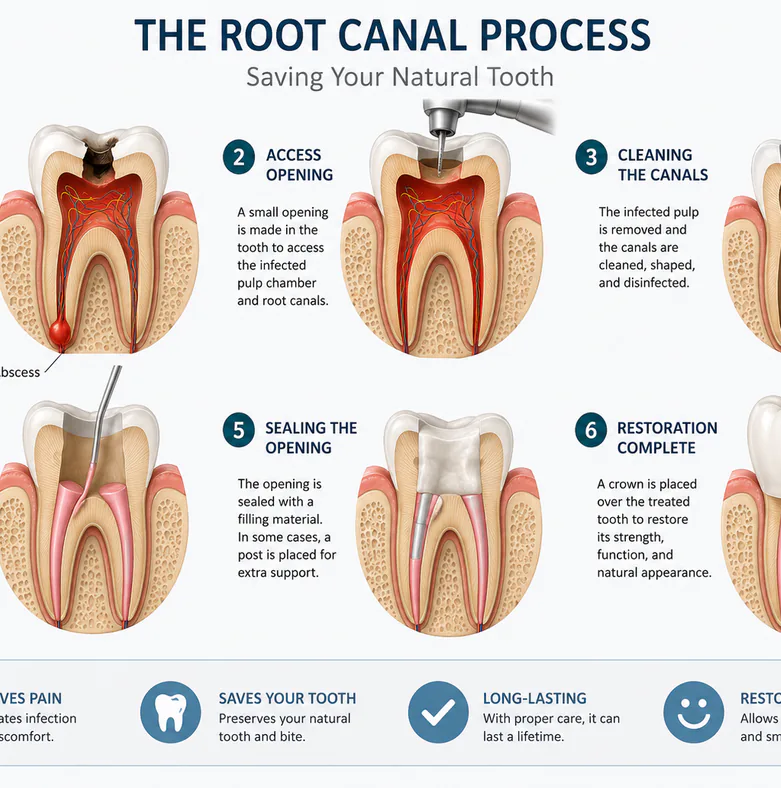
What is root canal therapy?

What is root canal therapy?

The pulp of a tooth contains nerves, blood vessels, and connective tissue, which help to nourish and maintain the health of the tooth. When the pulp becomes damaged or infected due to decay, injury, or trauma, it can cause significant pain, sensitivity, and swelling. In some cases, the infection can even spread to the surrounding teeth and gums, causing further complications.

Root canal therapy is a dental procedure that aims to remove the infected or damaged pulp from the tooth, clean and disinfect the root canals, and then fill and seal the space with a material called gutta-percha. The procedure is typically performed under local anesthesia, which ensures that the patient is comfortable throughout the treatment.

After the root canal procedure, the tooth may feel sensitive or tender for a few days, but this can usually be managed with over-the-counter pain relievers. In some cases, the dentist may recommend a dental crown or other restorative treatment to help strengthen the tooth and restore its function.

Overall, root canal therapy is an effective and safe treatment option for saving a damaged or infected tooth and preventing the need for extraction. It can help to alleviate pain and discomfort and restore the natural function of the tooth, allowing you to enjoy a healthy and beautiful smile.

Our Clinical Approach

The biggest misconception about root canals is that they are painful. Modern root canal therapy with good local anesthesia is typically no more uncomfortable than a large filling. What causes pain is the infection itself — and the root canal is what relieves it.

Saving the natural tooth is always the first goal when possible. An implant is a great replacement, but a healthy natural tooth anchored in its own bone is still better than anything modern dentistry can build. Root canal therapy is how teeth that would otherwise need extraction are saved.

Reviewed by our team · Finch Midland Dental, Scarborough, ON

Transcript
hi everyone my name is whitney and i am a dental hygienist if you're new here welcome if you've been here before welcome back let's talk about root canals what to expect are they painful how much do they cost and are they safe so if you want to understand what a root canal really is i'll link my video in the bottom below that explains everything about what it is why it is done but for the purpose of this video let's talk about the procedure itself and what to expect the first question i always get is are root canals painful and surprise root canal treatments don't actually hurt they get a bad rep because oftentimes people need root canals when their tooth is already in pain not always but often and that's why the tooth might hurt not because of the procedure itself but because your tooth is already hurting when you show up to the appointment and it's sometimes hard to get you numb when the tooth is so infected that it's causing you pain so if you are not in pain that's actually the best time to get your root canal before it hurts you because then you numb up very easily and the root canal procedure is super straightforward it will feel like you're getting any other routine dental treatment fillings crowns you'll be numb and you'll be good it's easy i really hope that makes sense knowing that getting a root canal is what helps combat the source of your pain rather than cause additional discomfort also if you are in pain and you're watching this video right now and you're like shoot great that's me my two thirds and i'm getting a root canal tomorrow in this case oftentimes your dentist would have already prescribed you an antibiotic and or something to help the swelling so always talk with your dentist about your individual concerns so they can accommodate you and make you more comfortable next question i always get are root canals safe and the answer is absolutely yes root canal treatments utilize safe high quality materials that are designed for long lasting support it's safer to get a root canal than it is to avoid treating your infected tooth especially when you consider that an untreated abscess could potentially cause a brain infection and put you in the hospital so really a root canal treatment is safe it prevents the infection from spreading because it gets rid of the infection and something else that's been circulating the internet about root canals being unsafe yet again giving root canals a bad reputation is something about harboring harmful toxins i've seen blogs and documentaries about this and it's unfortunately based off of nothing what a root canal does is the exact opposite it removes the harmful stuff from the tooth by cleaning it out disinfecting it and then filling in the cleaned up tooth so definitely important to know that root canals remove the harmful bacteria and stop it from spreading don't really understand where the disconnect where the confusion came from but yeah usually those blogs that are falsely claiming all that stuff often also pose the argument that keeping a tooth that was previously infected in your body will spread throughout your body and they always recommend and they're trying to persuade people that it's better to pull your tooth get an extraction and forget the root canal don't try to save it however again with a root canal it's removing the infection so if you're able to get a root canal always best to do that because it's always best to keep your natural teeth if you can opposed to pulling everything right away i always use the comparison of if you broke your arm say it got infected you wouldn't just cut off your arm right away that would not be the first option to treat an infection wouldn't you do everything you could to save your arm it's the same thing with teeth it's a last resort to pull a tooth so whenever you hear that root canals cause all this scary stuff just please know that is not the case there is literally no valid scientific evidence supporting any of those claims next question i get what should i expect during my appointment how long will it take now every tooth is super different it really depends on how many roots there are if they are all twisted and curved or if it's a simple single root so the only person who can tell you the best time estimate is your dentist or your endodontist whoever is doing your root canal for you they can examine your x-rays and examine your individual situation better than anyone online could tell you but in general what to expect at your root canal appointment you normally wouldn't need a driver you won't need someone to drive you to your appointment unless you are going to be totally knocked out which is rare because most of the time it's not recommended it's super normal to be awake and just get that tooth and that area of your mouth numbed up with local anesthetic if you are a little nervous sometimes some people ask for nitrous oxide you know the laughing gas to put your mind at ease but if for some reason you have super high anxiety or you're extremely nervous about being at the dentist in general talk with your dental provider and ask if they offer sedation it's of course what you are comfortable with so if you are going under you would need a driver but if you are not going under which is more common then you can drive yourself regardless of whether you're going under or not the tooth and the area around your tooth will still be numbed up and once you are numbed up lots of patients say that root canal procedures are actually boring because you just lay there it's kind of quiet there are some noises but it's nothing like getting fillings or crowns where there is loud drilling the whole time i always recommend my patients bring headphones or something to keep them entertained because truly boring is the most common review i've heard from my root canal patients you can always ask to watch the procedure too if they use a microscope and they have a tv sometimes they can connect it for the patient to watch kind of cool i do also have a video that shows a root canal procedure being done in the mouth with me voicing over each step which i think is pretty cool and lots of you might think it's pretty cool too so of course i'll link that video of mine in the bottom right below if you'd like to watch the step-by-step process and before we go let's talk about cost most dental insurances will cover root canal treatments however not all of them do so you'll need to verify your coverage to get a general idea of what your out-of-pocket expenses will be root canal costs depend on several factors such as the cost of living in your area whether you're seeing a general dentist or an endodontist which is the root canal specialist and even which tooth it is and how many roots there are so for a front tooth the average price is around 700 for a premolar it's usually around 850 and for a molar it's around 1200 again these are averages they can be super less or super more depending on where you live also lots of insurances may cover 50 of it or even 80 of it depending again on a million factors insurance is complicated but in general the more roots the more expensive so the molars will be the most expensive teeth to get root canals on and your front teeth will be the most affordable in conclusion always remember if you need a root canal and your dentist is recommending it's the best treatment for your individual tooth in question it is always best to save your natural teeth also the overall root canal cost can actually save you money and time in the future when compared to extracting the tooth and then getting a dental implant placed in that site and lastly if your tooth in question is not salvageable your dentist does not think a root canal can save it i do have a video all about the different tooth replacement options so i'll also link that video in the bottom bar below if you'd like to learn more about implants bridges partials all the different options to replace a tooth but really if you can get a root canal to save your tooth if it's recommended then it's always best to have your own tooth in your mouth i hope this video helped you please like subscribe and turn on your notifications if it did i'll link all the videos i mentioned in the bottom right below and until next time i'll see you on instagram teeth talk girl peace love auntie [Music]

What to expect during root canal treatment

Expect Anesthesia
Patients often express fear of pain during root canals, expecting to feel every step of the procedure. However, anesthesia will be provided by the dentist. Local anesthetic blocks pain signals between the nerves of the tooth and the brain. Although certain stimuli may still be felt, they should not be painful. In some cases, repeated administrations of local anesthetic may be necessary for teeth that are difficult to numb. It’s important to note that pain during a root canal may occur of the tooth is already infected. The pain may be a result of the infection and the actual root canal procedure.

Expect a Strange Barrier Device called a Rubber Dam
The rubber dam is a crucial part of the root canal procedure. It’s a square piece of rubber or non-latex material that the dentist places over the tooth that’s being treated. This barrier device keeps the working field sterile and dry, preventing any bacteria from contaminating the open tooth. It also protects the surrounding gum tissue, cheeks, lips, and tongue from the materials used in the root canal procedure. By using a rubber dam, the dentist can ensure a successful root canal treatment that lasts.

Expect Lots of X-rays
To ensure tools and materials are positioned correctly during a root canal procedure, the dentist will use multiple x-rays. Digital dental x-rays make this step quick and easy. Although some patients may worry about “lots of x-rays,” taking several x-rays from different angles is a normal and necessary part of the procedure. In fact, you might not even notice the x-rays being taken due to the speed and efficiency of digital technology.

Expect Minor Pressure and Scratching Sensations
Local anesthesia can effectively block pain signals, but it cannot block the feeling of pressure. During root canal treatments, patients can still experience movements, pressure, and scratching sensations. It may be difficult to differentiate between these sensations and what can be seen or heard during the procedure. However, you can always ask for more local anesthesia if you feel any pain, to ensure maximum comfort during the treatment.

Expect Moderate Pain after the Procedure
Root canal patients may experience moderate pain after the procedure due to the body’s natural response to inflammation caused by the trauma of dental treatment. Oral antibiotics may be necessary for those with large infections before the procedure, and post-operative pain is usually manageable with over-the-counter medication. In cases of severe pain we can prescribe pain relievers.

More Questions about Root Canals?
Contact our office today to schedule a consultation. We can answer any question you have about root canals and address any issues unique to your specific situation. We look forward to seeing you.

What are the symptoms or signs that a root canal is needed?

There are several symptoms and signs that indicate a root canal may be needed. These include:

  • Persistent pain: If you experience persistent pain in your tooth, especially when you apply pressure or chew, it could indicate that you need a root canal.
  • Sensitivity to hot and cold: If your tooth is sensitive to hot and cold temperatures even after the source of the temperature is removed, this could be a sign of root canal problems.
  • Gum swelling: If the area around the affected tooth is swollen, it could indicate an infection that may require a root canal.
  • Discoloration: A tooth that has darkened or changed color may be a sign that the nerve of the tooth is damaged and a root canal may be necessary.
  • Pus drainage: If you notice pus around the affected tooth, this could indicate an abscess, which often requires a root canal.

If you experience any of these symptoms or signs, it’s important to schedule a consultation with our Scarborough root canal dentist to determine if a root canal is necessary.

Why is root canal therapy necessary?

Why is root canal therapy necessary?

When the nerves inside the tooth pulp die, the tooth dentin and enamel can no longer receive organic nutrients and moisture. The inflamed tissue surrounding the tooth causes toothache and infection can damage the bones around the teeth. If the damaged pulp is not treated, bacterial infection and inflammation can loosen the tooth and it may have to be removed. Therefore, root canal therapy is necessary to preserve the tooth and also protect the jawbone.

Key Benefits

Why Choose This Treatment

Saves Your Natural Tooth

Keeping your natural tooth avoids the need for an implant, bridge, or denture — and nothing functions or feels as good as your original tooth.

Eliminates Pain and Infection

Removing the infected pulp stops the source of your toothache immediately and prevents the infection from spreading to adjacent teeth or the jawbone.

Same-Day Relief Available

Root canal treatment can be performed the same day for patients in acute pain, providing immediate relief from the severe discomfort of a dental abscess or pulp infection.

Modern Comfortable Technique

With today's anesthetics, rotary instruments, and magnification technology, root canals are performed efficiently and with minimal discomfort for the patient.

Crown Protects the Tooth

A crown placed after root canal therapy seals and strengthens the treated tooth, restoring its full function and protecting it from fracture for years to come.

Worried about needing a root canal? The procedure itself is far less daunting than the infection it resolves. your dentist and the Finch Midland Dental team prioritize your comfort at every step — from administering anesthesia through post-treatment care instructions.
Is This Right For You

Is Root Canal Therapy Right for You?

Root Canal Therapy is a good fit if you are:

  • Patients with severe toothache from pulpal inflammation or infection
  • Patients with a deep cavity reaching the tooth pulp
  • Patients with a cracked tooth affecting the pulp
  • Patients with a dental abscess related to a specific tooth

This may not be the right option if:

  • Teeth with vertical root fractures (usually not restorable)
  • Teeth with severely inadequate remaining structure
  • Patients with active gum disease around the tooth affecting prognosis
Step By Step

What to Expect During Your Root Canal Therapy Visit

Here is exactly what happens at your appointment at Finch Midland Dental. Knowing each step makes the experience far less intimidating — and lets you relax knowing what comes next.

  1. 1. Diagnosis. our team tests the tooth with cold or warmth, taps it lightly, and takes an x-ray or CBCT. The goal is to confirm which tooth is the problem.
  2. 2. Numbing and isolation. Local anesthesia is given. A rubber dam is placed around the tooth to keep it clean and dry — essential for success.
  3. 3. Cleaning the canals. our team makes a small opening in the top of the tooth, removes the infected pulp, and uses tiny rotary files to clean and shape each canal. You feel pressure and vibration, not pain.
  4. 4. Filling and sealing. The cleaned canals are filled with gutta-percha (a rubbery material) and sealed. A temporary filling protects the tooth until the final crown is placed.
  5. 5. Crown placement. Most root-canaled teeth receive a crown afterward to protect from fracture. This happens at a follow-up visit.
Common Concerns

Common Concerns About Root Canal Therapy

These are the questions patients at Finch Midland Dental ask most often before committing to treatment. our team addresses each one honestly at your consultation.

"Root canals are the most painful dentistry"

Myth. The pain patients associate with root canals comes from the infection itself, not the procedure. Done under local anesthesia, the root canal is what ends the pain — typically no more uncomfortable than a large filling.

"Wouldn't it be easier to just pull the tooth?"

Extraction is faster and cheaper short-term, but the gap then needs replacement (implant, bridge, or partial) — which costs far more than the root canal would have. Saving the natural tooth is almost always better.

"Root canals fail often"

Modern root canal success rates exceed 90%. our team uses rubber dam isolation, digital magnification, and modern rotary instruments to maximize success.

What to Know

Risks and Considerations of Root Canal Therapy

Every procedure has tradeoffs, and transparent conversation about them is part of informed consent. our team reviews these at your consultation and answers every question before treatment begins.

  • Possible re-infection if bacteria persist in the canal system
  • Tooth fracture is possible over time, especially without a crown
  • Missed canals can cause persistent symptoms (rare with experienced dentist)
  • Very rarely, the tooth cannot be saved and extraction is needed
Common Questions

Frequently Asked Questions About Root Canal Therapy

While root canals have a reputation for being painful, modern techniques and anesthesia make the procedure relatively painless. You may experience some discomfort after the procedure, but it can usually be managed with over-the-counter pain medication.

The length of a root canal procedure depends on the complexity of the case and how many teeth are being treated. Most root canals can be completed in one to two appointments.

You may need a root canal if you have a deep cavity, a cracked tooth, or an injury that has damaged the pulp inside your tooth. If left untreated, this can lead to an abscess or even tooth loss.

In most cases, it is recommended to get a crown after a root canal to protect and strengthen the tooth. A crown can also improve the tooth’s appearance.

A tooth that has had a root canal can last for many years with proper care.

Yes. At our Scarborough dental office we offer root canal treatment to patients from Scarborough and the surrounding area. Contact our office today to schedule an appointment.

Modern root canal procedures are performed under local anesthesia and are typically no more painful than a large filling. Post-procedure soreness is usually manageable with over-the-counter pain medication. The severe pain most people associate with root canals comes from the infection — the procedure relieves it.

Most root canals are completed in 1–2 appointments, each lasting 60–90 minutes. After the root canal, a crown is usually placed on the tooth to protect it from fracture.

Most dental insurance plans cover root canals at 50–80% as a major or basic service. We verify your benefits before treatment and provide a clear cost estimate.

Medical Disclaimer

This content is for informational purposes only and does not constitute dental or medical advice, diagnosis, or treatment. Root canal therapy carries risks including re-infection, tooth fracture, missed canals, and the rare need for retreatment or extraction if the procedure fails. Modern techniques and rubber dam isolation minimize these risks. Consult our team or a qualified dental professional regarding any questions about your oral health. Individual results may vary.

Learn More About Root Canal Therapy

Contact our office to discuss how this treatment can help you achieve your dental health goals.